



Google confirmed four core updates and three spam updates in 2024, plus three new spam policies. The biggest change came in March, when the helpful content system was folded into Google’s core ranking systems and new policies targeted scaled content, expired domains and site reputation abuse. Together they rewarded original, people-first content and made shortcuts such as mass-produced pages much riskier.
This page is a record of what Google confirmed in 2024, with dates taken from Google’s search updates page and its Search Status Dashboard. At the end you will find a short summary of what has changed since, up to November 2026.
Google algorithm updates in 2024 at a glance
| Update | Started | Completed |
|---|---|---|
| March 2024 core update | 5 March | 19 April |
| March 2024 spam update | 5 March | 20 March |
| Site reputation abuse enforcement begins | 5 May | Ongoing policy |
| June 2024 spam update | 20 June | 27 June |
| August 2024 core update | 15 August | 3 September |
| November 2024 core update | 11 November | Early December |
| December 2024 core update | 12 December | 18 December |
| December 2024 spam update | 19 December | 26 December |
The key 2024 updates explained
March 2024 core update
This was one of the largest core updates Google has released. It changed several core ranking systems at once and took 45 days to roll out, much longer than the usual two weeks or so. Google said the aim was to show less content made mainly to attract clicks and more content people find useful.
The most important structural change was that the helpful content system, launched in 2022 as the “helpful content update”, stopped being a separate system and became part of Google’s core ranking systems. Since then there have been no standalone helpful content updates; helpfulness is assessed as part of every core update.
What it meant in practice:
- Thin pages written to match search terms, rather than to help a reader, lost visibility.
- Sites publishing original content from people with real knowledge of the subject tended to hold or gain ground.
- Google’s position was about quality, not about how content was made. Unhelpful content was affected whether a person or an AI tool wrote it.
March 2024 spam update and three new spam policies
Alongside the core update, Google ran a spam update (5 to 20 March) and added three new spam policies:
- Scaled content abuse: producing large numbers of pages mainly to manipulate rankings, whether by automation, people or a mix of both.
- Expired domain abuse: buying an expired domain and reusing its reputation to rank low-value content.
- Site reputation abuse: publishing third-party content on a trusted site to exploit that site’s ranking signals, sometimes called “parasite SEO”. Enforcement began on 5 May 2024.
June 2024 spam update
A shorter spam update ran from 20 to 27 June. Google said it was a regular spam update rather than the planned algorithmic part of the site reputation abuse policy.
August 2024 core update
Google said this update continued the work started in March, aiming to show more content people find genuinely useful. It also said it took into account feedback from creators and aimed to surface a range of high-quality sites, including small or independent sites creating useful, original content. Some sites hit in March saw partial recoveries, although many did not.
Site reputation abuse clarified (November 2024)
On 19 November 2024 Google clarified that using third-party content on a site to exploit the site’s ranking signals breaks the policy even when the host site is involved in or oversees that content. This mainly affected large publishers running coupon, product review and affiliate sections written by outside partners.
November and December 2024 core updates
Google ran two more core updates in quick succession: November (11 November to early December) and December (12 to 18 December). Google described both as regular updates to its core systems and did not publish specific targets. The December spam update followed from 19 to 26 December.
AI Overviews reach the UK
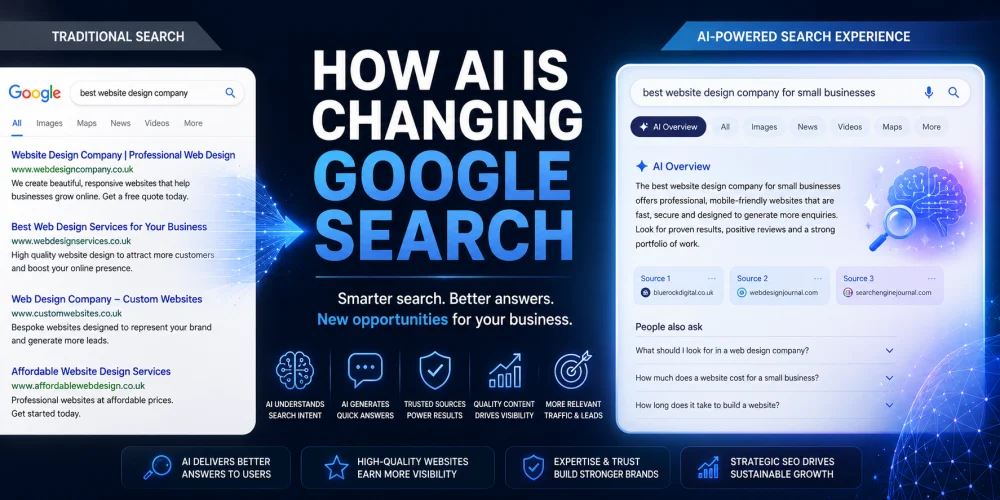
Not an algorithm update, but one of the biggest search changes of 2024: AI Overviews launched in the US in May and rolled out to the UK and five other countries in August 2024. For the first time, many UK searches showed an AI-written summary above the organic results, with links to the sources it drew on.
What these updates rewarded
Looking across the year, the same themes kept coming up:
- People-first content: pages written to answer a real question fully, rather than to target a keyword.
- Experience and expertise: content that shows first-hand knowledge. Google’s quality rater guidelines describe this as E-E-A-T (experience, expertise, authoritativeness and trust).
- Clean link profiles: links earned naturally, not bought or swapped. Our guide to link building for SEO covers what still works.
- A good page experience: fast, mobile-friendly pages without intrusive pop-ups. In March 2024 Interaction to Next Paint (INP) replaced First Input Delay as a Core Web Vital.
For a detailed breakdown of what Google weighs most heavily, read our guide to the most important SEO ranking factors.
How to respond if your rankings dropped
- Check the timing. Compare your traffic in Google Search Console with the update dates above. A drop during a rollout window is a clue, not proof.
- Look at the pages that lost traffic. Ask honestly whether each one is the most helpful answer to the search it ranked for.
- Improve or remove thin pages. Merge near-duplicate location or service pages, and update out-of-date content.
- Show who is behind the content. Add author details, real examples and evidence of first-hand experience.
- Audit your links. Stop any paid or exchanged links that are not marked as sponsored.
- Be patient. Google says some improvements show within days, but it can take several months for its systems to confirm them, and sometimes that means waiting until the next core update.
What has changed since 2024
The direction set in 2024 has held. Here is what Google has confirmed since, up to November 2026:
- 2025 core updates: March (from 13 March), June (from 30 June) and December (from 11 December). See our guide to why Google’s core updates matter and how to respond.
- 2025 spam update: August (26 August to late September).
- AI Mode in the UK: Google’s conversational AI Mode launched in the UK at the end of July 2025, adding another place where answers are summarised rather than listed.
- 2026 so far: a February Discover update, spam updates in March, June, August and September, and core updates in March and May. The November 2026 core update started on 10 November and had not been marked complete at the time of writing.
The practical lesson is the same as in 2024: build pages that genuinely help your customers and show your real expertise. Increasingly, that is also what gets a business cited in AI Overviews, AI Mode and tools such as ChatGPT and Perplexity.
Frequently asked questions
How many core updates did Google release in 2024?
Four: March, August, November and December 2024. Google also released three spam updates, in March, June and December.
Was there a helpful content update in 2024?
No standalone one. In March 2024 the helpful content system became part of Google’s core ranking systems, so helpfulness is now assessed in every core update.
Did Google penalise AI-generated content in 2024?
Not for being AI-generated. Google’s policies target unhelpful content and content produced at scale to manipulate rankings, however it is made. Useful, accurate content is not penalised because a tool helped to write it.
How long does it take to recover from a core update?
There is no fixed time. Google says some changes take effect in a few days, but it can take several months for its systems to confirm improvements, and sometimes that means waiting until the next core update. Recovery is not guaranteed.
Need help with algorithm changes?
Our SEO services include monitoring of algorithm changes so you know what has changed and what to do about it. If you also want your business to be found and cited in AI search, see our AI visibility (GEO) services.