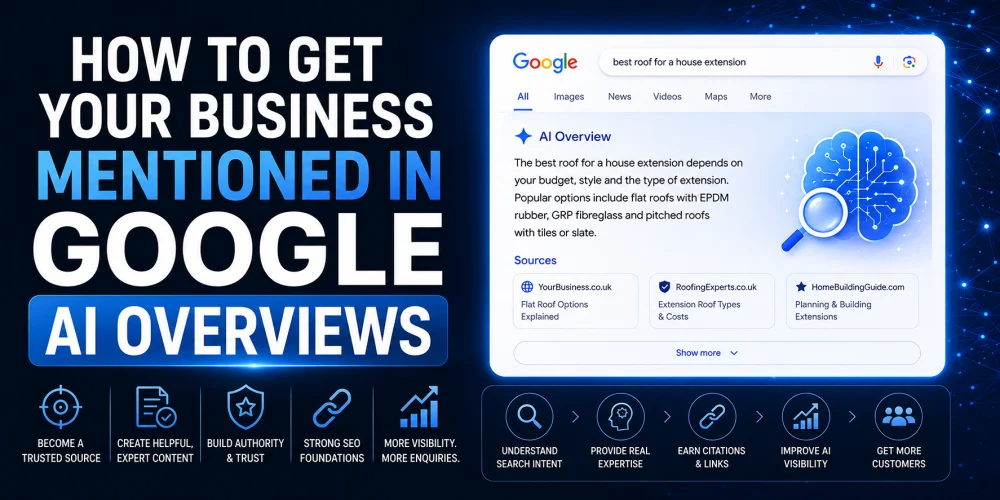

If you want to appear in AI search results, you need to do more than optimise for Google. Platforms like ChatGPT, Perplexity, Google Gemini, and Google AI Overviews now answer questions directly. The businesses that get cited in those answers do not get there by accident. They get there because their content is structured, authoritative, and easy for AI systems to extract and verify. At Blue Rock Digital, we have been working on AI search visibility for our clients since these platforms started gaining real traction. In this guide, we walk you through what actually influences whether your business appears in AI-generated answers, and what you can do about it.
What AI Search Results Are and Why They Matter
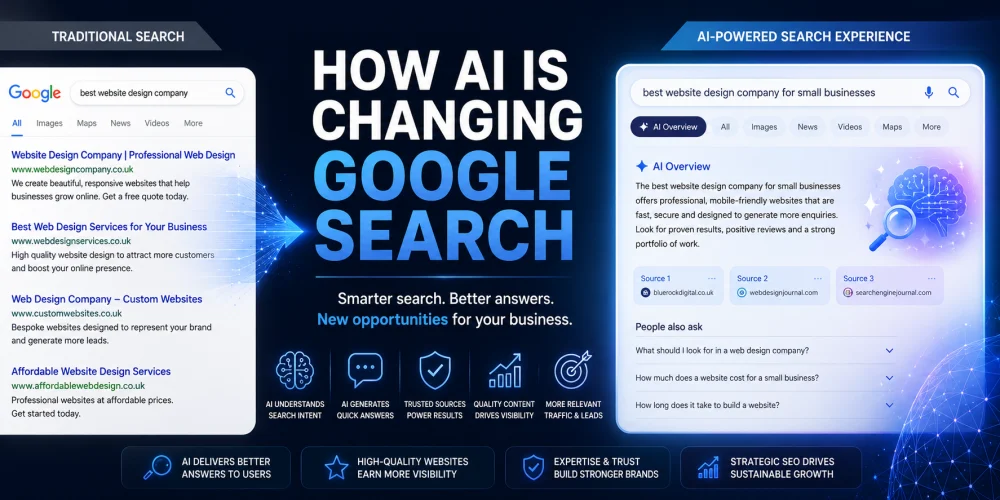
AI search platforms do not work like traditional search engines. Rather than listing ten blue links, they read across multiple sources and generate a single, synthesised answer.
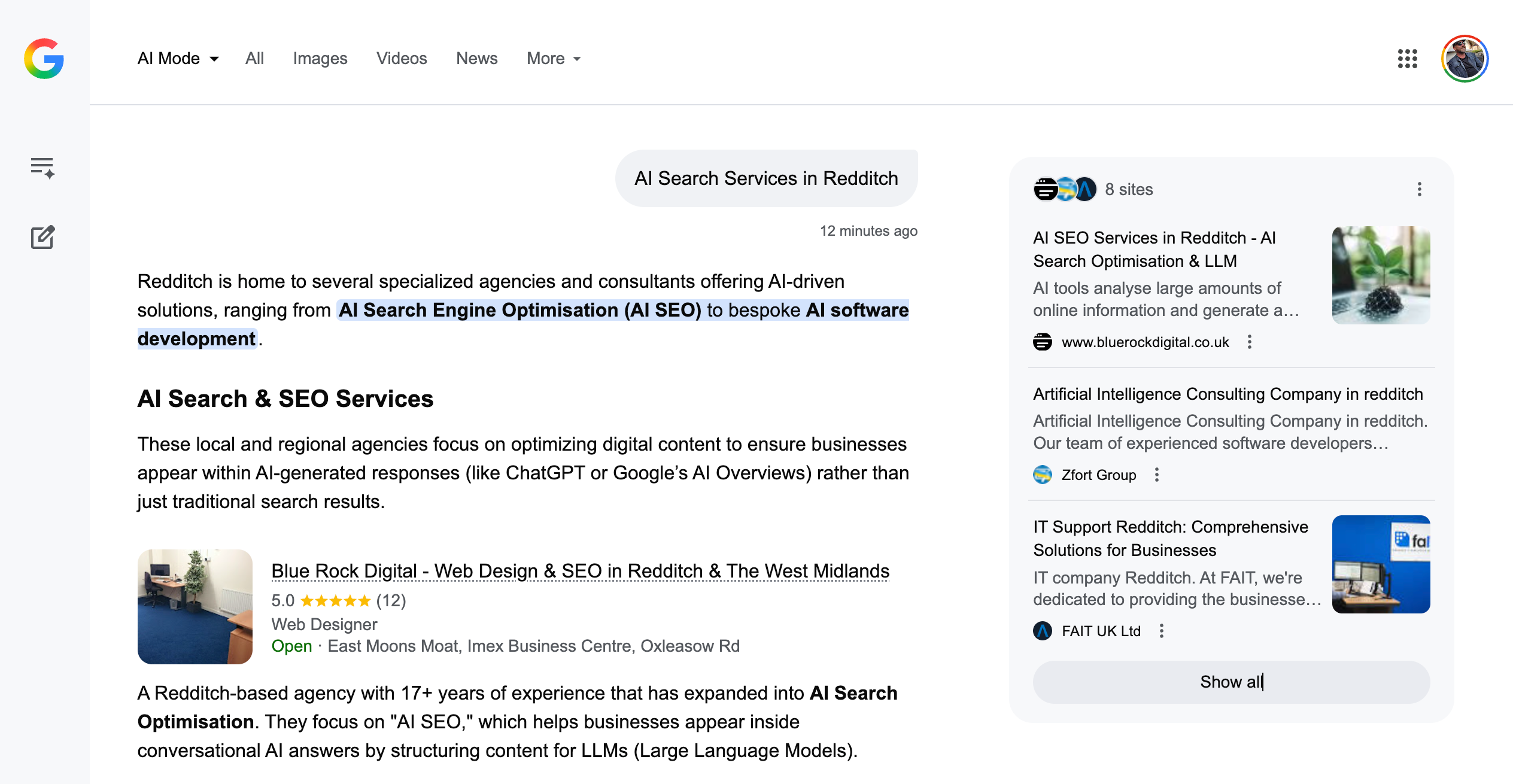
When a user asks ChatGPT “who does SEO in Redditch” or asks Google AI Overviews “what is generative engine optimisation”, the platform pulls from sources it considers trustworthy and well-structured.
This matters for two reasons. First, businesses that appear in those answers gain significant authority with the user, often before anyone has visited a single website. Second, businesses that do not appear are effectively invisible to a growing portion of the population that now turns to AI platforms before, or instead of, a traditional Google search. According to Google’s own AI search documentation, AI Overviews appear for a wide and growing range of queries. The content that Google cites must be indexed and eligible to appear as a snippet in standard search. In other words, AI visibility starts with solid SEO foundations. To understand the broader picture of how AI search is changing things, our post on how AI is affecting Google searches is a useful starting point.
The Foundation for Appearing in AI Search Results
Before any AI platform will cite your business, it needs to find you, read you, and trust you. Three things need to be in place.
Technical eligibility for AI search
Your pages must be properly crawlable and indexed. If Googlebot cannot read your content, Google AI Overviews will not cite it. If you block AI crawlers like OAI-SearchBot in your robots.txt, ChatGPT will not surface your content in search results either. Check your Google Search Console for indexing issues and make sure your robots.txt does not block important pages or resources.
Content that directly answers questions
AI systems are sophisticated answer machines. They look for content that directly and clearly responds to the question a user has asked. Vague introductions, filler sentences, and bloated sections that delay the answer all reduce the likelihood of getting cited. Put the answer early. Use plain language. Be specific.
Consistency across the web
AI platforms do not rely only on your website to assess your credibility. They cross-reference your business across directories, review platforms, and third-party mentions. Your name, address, and phone number need to appear consistently everywhere. Keep your Google Business Profile complete and active. Reviews also matter — they need to reflect real client experience. This is the same work that local SEO has always required, and it carries even more weight in an AI search context.
How to Structure Content to Appear in AI Search Results
Structure is one of the most important factors in whether AI systems choose to cite your content. Here is what to get right.
Use clear headings that reflect real questions
AI platforms use headings to understand what a section covers and whether it is relevant to the query. A heading like “Our Approach” tells an AI system nothing. A heading like “How Long Does SEO Take to Show Results?” tells it exactly what follows. Write your H2 and H3 headings as direct questions or clear statements, not vague labels.
Lead each section with a direct answer
After each heading, the first one or two sentences should directly answer the question. Do not build to the answer. Start with it, then add supporting detail below. This passage is what AI systems are most likely to extract and cite, so make it count.
Use lists and tables for structured information
When you compare options, list steps, or summarise key points, use a bulleted or numbered list rather than a paragraph. AI systems parse structured content more reliably than flowing prose. A clean list is also easier for a user to read quickly once cited in an AI answer.
Write in self-contained sections
Each section of your content should make sense on its own. AI systems often extract individual passages rather than entire pages. If a section only makes sense with context from earlier in the post, it is less likely to get cited cleanly. For a deeper look at structuring content for AI extraction, our post on how to optimise a website for AI search engines covers the technical side in detail.
Build Topical Authority to Appear in AI Search Results
AI platforms are more likely to cite websites that demonstrate genuine expertise across a topic, not just on a single page. This is why content clusters matter.
If you run a web design and digital marketing agency, one page about SEO and one page about Google Ads is not enough. You need multiple in-depth posts covering related questions, all linking back to your core service pages.
This interconnected content signals to both search engines and AI systems that your site is a reliable, comprehensive source on the subject.
At Blue Rock Digital, we have built our content around exactly this model. Our GEO services page sits at the centre of a cluster of posts covering AI search, llms.txt, AI Overviews, and more. Each post reinforces the others and strengthens the signal that we are genuine specialists in this area. Building topical authority takes time, but it compounds. Every well-structured post you publish in your niche makes the next one more credible in the eyes of AI systems.
Schema Markup and AI Search Visibility
Schema markup labels your content so that search engines and AI systems can understand it more precisely. It does not guarantee you will appear in AI results, but it removes ambiguity about who you are, what you offer, and how to contact you. The schema types most relevant to appearing in AI search results are:
- LocalBusiness schema — confirms your business name, address, phone number, and service area
- FAQPage schema — marks up question-and-answer content so AI systems can identify and extract it reliably
- Service schema — describes what you do with enough precision that AI systems can match your services to relevant queries
- Article or BlogPosting schema — signals that a page is editorial content with a named author and a published date
If you use Yoast SEO on WordPress, much of this works with some basic configuration. For your key service pages, you need to add custom schema manually. Our SEO services include schema implementation as standard across all pages.
E-E-A-T: Experience, Expertise, Authoritativeness, and Trustworthiness
Google introduced E-E-A-T as a framework for assessing content quality, and the same principles apply to AI search visibility.
AI platforms favour content that demonstrates real expertise, has a named and credible author, and carries genuine authority signals from across the web.
In practice, this means several things for your website.
Blog posts should have a named author with a brief bio that explains their relevant experience. If you have worked in your industry for fifteen or twenty years, that context belongs on your website in a way that AI systems can read and reference. Generic advice that could have come from anywhere carries little weight. Case studies, client outcomes, and examples drawn from actual work are harder to fabricate. They carry stronger credibility signals as a result. Professional memberships, accreditations, reviews on third-party platforms, and media mentions all contribute too. These are the external signals AI systems use to assess how much to trust your content. To learn more about why these signals matter and how GEO differs from traditional SEO, our post on what GEO is and why your business needs it explains the distinction clearly.
llms.txt: Giving AI Systems a Direct Map of Your Site
One of the newer developments in AI search optimisation is llms.txt. This is a plain-text file you publish at the root of your website to give AI systems structured guidance on what your site contains and how it is organised. It is not a ranking factor in the traditional sense, but it reduces friction for AI crawlers and helps them understand your site more accurately. We have llms.txt live on the Blue Rock Digital website, and it auto-regenerates every six hours as we update our content. For a full explanation of what it is and how to implement it, our post on what llms.txt is and how it works covers everything you need to know.
Frequently Asked Questions About AI Search Results
How long does it take to appear in AI search results?
There is no fixed timeline. Some changes, such as fixing indexing issues or adding structured FAQ content, can produce results within a few weeks. Building genuine topical authority and consistent external signals is a longer-term process. Most clients see meaningful improvement within three to six months of consistent work.
Which AI platforms should I focus on?
The four platforms with the most relevance for UK businesses right now are Google AI Overviews, ChatGPT, Google Gemini, and Perplexity. Google AI Overviews reaches the largest audience because it sits directly inside Google Search. ChatGPT has the largest standalone user base globally. Perplexity and Google Gemini are both growing rapidly. The same content optimisation work improves your visibility across all four.
Do I need a separate strategy for each AI platform?
Not entirely. The foundations are the same across all platforms: well-structured content, strong E-E-A-T signals, consistent NAP data, and good schema markup. Where strategies diverge is in the technical access layer. Making sure the right crawlers have access is platform-specific, but the content work is shared.
Can a small business compete with large brands in AI search?
Yes. AI search does not run purely on domain authority the way traditional search has. A small business that publishes genuinely useful, well-structured, locally specific content, and builds real reviews and directory presence, can get cited ahead of a large brand that has not done this work. We see it with our own clients.
Is GEO the same as SEO?
They overlap significantly but are not identical. SEO focuses on ranking in traditional Google search results. GEO (Generative Engine Optimisation) focuses on getting cited in AI-generated answers. The foundations of both are the same: technically sound websites, quality content, and strong authority signals. GEO adds specific techniques around content structure, schema, llms.txt, and brand mention strategy that standard SEO does not cover.
How Blue Rock Digital Helps You Appear in AI Search Results
Sean O’Donoghue founded Blue Rock Digital in 2008. The agency has spent the last seventeen years helping UK businesses get found online. As AI search has grown from a novelty into a genuine channel, we have built a dedicated GEO practice that sits alongside our SEO and web design work. Our GEO services cover the full picture: AI visibility audits showing where you currently stand across ChatGPT, Perplexity, Google Gemini, and Google AI Overviews; content structuring to make your pages more extractable; schema markup implementation; llms.txt setup; and ongoing monitoring as the AI search landscape evolves. If you want to understand how visible your business currently is in AI search, and what is holding you back, get in touch for a free consultation.