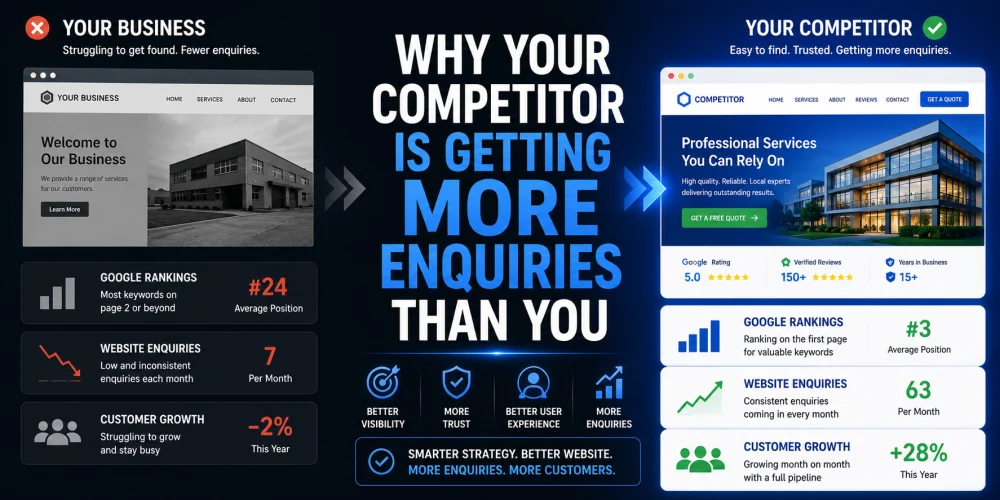
Have you ever looked at a competitor and wondered why they seem to be winning more work, despite offering similar services at similar prices? It is a question many business owners ask themselves, particularly when they know they provide an excellent service.
The truth is that success online rarely happens by chance. Businesses that consistently generate more enquiries usually have a stronger digital marketing strategy, a better-performing website and a greater understanding of how customers search for products and services.
Today’s customers compare businesses before making contact. They visit multiple websites, read reviews, compare services and look for signs that a company is trustworthy. If your competitor creates a better first impression, they are far more likely to receive the enquiry.
Fortunately, these differences are often easier to fix than many business owners realise.
They’re Easier to Find on Google
The first challenge is visibility.
If potential customers cannot find your website, they cannot enquire about your services. Even if your website is excellent, it will struggle to generate leads if it sits on the second or third page of Google.
Better search engine optimisation
Businesses that appear near the top of Google’s search results usually invest in ongoing search engine optimisation rather than treating it as a one-off project.
They regularly improve existing pages, publish new content, optimise technical performance and monitor their rankings. As a result, they continue attracting new visitors while competitors fall behind.
A stronger Google Business Profile
For local businesses, a well-optimised Google Business Profile can be just as valuable as a website.
Companies that regularly update their profiles, upload photos, collect reviews, and answer customer questions often appear more prominently in Google Maps and local search results.
This increased visibility naturally leads to more phone calls, website visits and enquiries.
Local SEO makes a difference
Successful businesses also understand the importance of local SEO.
Rather than targeting broad national searches, they optimise their website for the towns, cities and counties they serve. They build dedicated location pages, create locally relevant content and earn links from trusted organisations within their area.
These small improvements help Google understand where the business operates and who it serves.
Their Website Builds Trust Immediately
Imagine visiting two websites offering the same service.
One looks modern, loads quickly, and clearly explains the process. The other feels outdated, contains blurry images and hasn’t been updated for several years.
Which business would you contact?
Most people make this decision within seconds.
Professional design is only part of the equation. Successful websites also include strong trust signals that reassure potential customers.
These may include verified customer reviews, before-and-after photographs, detailed case studies, industry accreditations, guarantees and clear contact information.
Every trust signal reduces uncertainty and makes it easier for someone to choose your business over a competitor.
They Answer Customer Questions Better
People visit your website because they have questions.
They want to know whether you provide the right service, how the process works, what makes your business different and why they should trust you.
Businesses that consistently generate more enquiries answer these questions before the customer even picks up the phone.
Instead of writing vague marketing copy, they produce genuinely helpful content that explains their services in detail.
Their website might include comprehensive service pages, frequently asked questions, detailed guides, pricing information where appropriate and helpful blog articles that solve common customer problems.
This approach benefits both users and search engines.
Google increasingly rewards websites that demonstrate genuine expertise and provide useful, people-first content.
They Make It Easy to Contact Them
Many websites unintentionally create barriers that discourage enquiries.
A hidden contact page, a lengthy enquiry form or unclear calls to action can all reduce conversion rates.
Successful businesses make it as simple as possible to contact them.
Their phone number is clearly visible.
Their enquiry form requests only the information they actually need.
Their calls to action are direct and persuasive.
Visitors always know what to do next, whether that’s requesting a quote, booking a consultation or asking a question.
Small usability improvements often produce surprisingly large increases in enquiries.
They Invest in Their Website Every Month
One of the biggest differences between successful businesses and those that struggle online is consistency.
Many companies launch a website and rarely update it again.
Their competitors take a different approach.
They regularly publish new blog articles.
They add recent projects and case studies.
They update service pages.
They improve website speed.
They monitor search rankings.
They refine their calls to action.
Over time, these incremental improvements compound into significantly better search visibility and higher conversion rates.
Google also favours websites that remain active and continue providing fresh, relevant information.
They Understand What Customers Are Really Searching For
Modern SEO is no longer about targeting individual keywords.
Instead, successful businesses focus on search intent.
Someone searching for “How much does roof cleaning cost?” has different needs from someone searching for “Roof cleaning company near me.”
The first person wants information.
The second person is ready to hire.
Businesses that understand this difference create content for every stage of the customer journey.
Informational articles build trust and attract early-stage visitors.
Service pages convert people who are ready to make contact.
This balanced approach generates a steady flow of enquiries over time.
They Measure Everything
Successful businesses rarely guess what works.
Instead, they rely on data.
They monitor website traffic, search rankings, enquiry forms and user behaviour.
By analysing this information, they can identify which pages generate the most enquiries and which areas require improvement.
This allows them to make informed decisions rather than relying on assumptions.
Over time, data-driven improvements produce better results than occasional redesigns or random marketing activities.