
Search has changed more in the last two years than it did during the previous decade. Artificial intelligence is now transforming how people discover information online, and businesses everywhere are asking the same question: How AI Is Changing Google Search and what does it mean for their website?
If you’ve noticed Google answering questions directly at the top of the search results or providing AI-generated summaries before displaying traditional website listings, you’re seeing this transformation in action. Google’s AI-powered search experience aims to deliver faster, more comprehensive answers, helping users find the information they need with fewer clicks.
Naturally, this has raised concerns among business owners. Will fewer people visit websites? Is SEO still worthwhile? Can AI replace the need for high-quality content?
The reality is far more encouraging. While search is evolving rapidly, the fundamentals of successful SEO remain the same. Businesses that invest in trustworthy, well-structured websites and genuinely helpful content are well placed to benefit from these changes rather than fear them.
In this guide, we’ll explain how AI is reshaping Google Search, why quality content matters more than ever and what practical steps your business can take to remain competitive in an AI-driven search landscape.
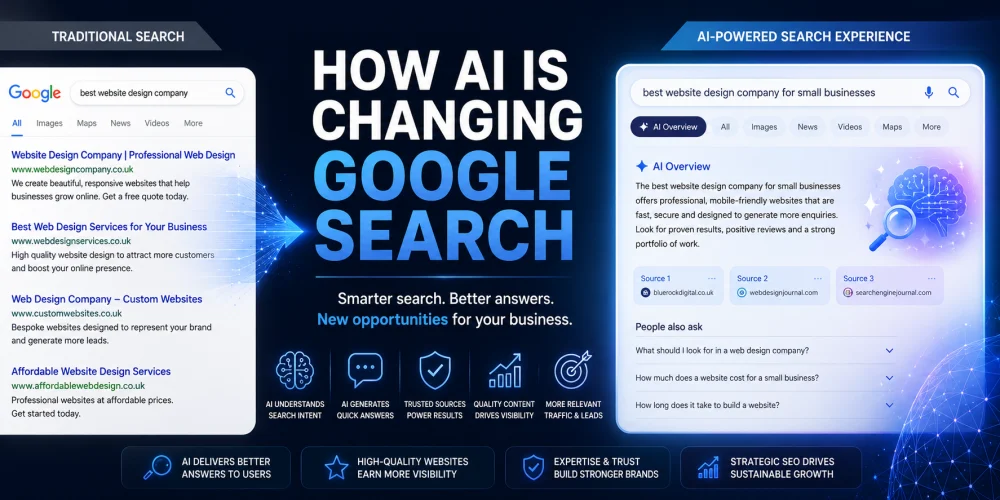
How AI Is Changing Google Search
For many years, Google’s search results followed a familiar pattern. Users entered a keyword, Google analysed billions of webpages and displayed the most relevant websites based on hundreds of ranking signals.
Today, that experience looks very different.
Artificial intelligence now plays a much greater role in understanding search intent, interpreting complex questions and generating summaries that help users find answers more quickly.
Rather than simply matching keywords, Google now focuses on understanding the meaning behind each search. This allows it to answer longer, conversational queries with far greater accuracy.
For businesses, this means websites must do more than target keywords. They need to provide comprehensive, reliable information that genuinely answers users’ questions.
What Are AI Overviews?
AI-generated summaries
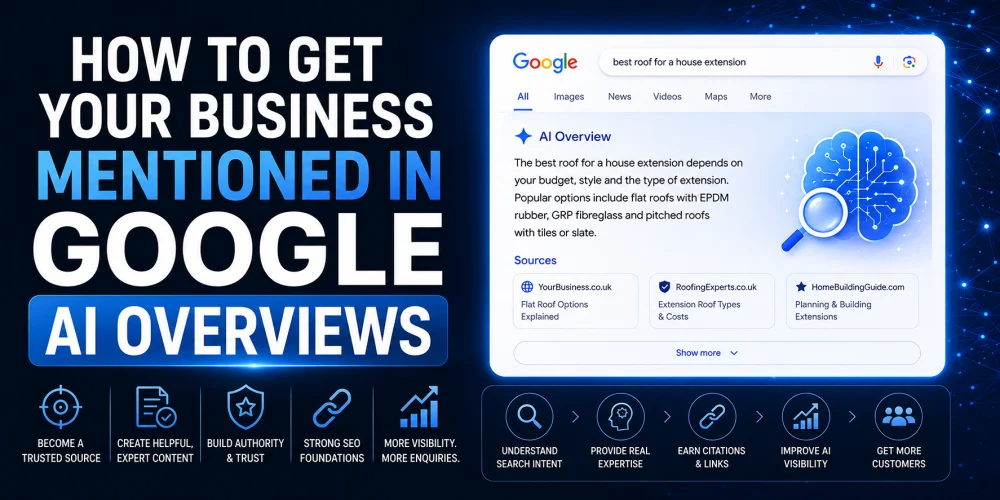
One of the biggest developments in Google Search is the introduction of AI Overviews.
Instead of presenting only a list of blue links, Google may generate a concise summary that combines information from multiple trusted sources. These summaries appear at the top of selected search results and aim to answer the user’s question immediately.
Websites still power AI answers
Although AI creates the summary, it does not invent the information.
Google continues to rely on high-quality websites as the source of its answers. Pages that demonstrate expertise, authority and trustworthiness remain essential to Google’s ecosystem.
In other words, websites haven’t become less important. They have become even more valuable because they provide the information AI needs.
Not every search uses AI
It’s also worth noting that AI Overviews do not appear for every search.
Many commercial searches, local searches and highly specialised topics still rely heavily on traditional search results. Businesses, therefore, need a balanced SEO strategy that performs well across both AI-powered and conventional search experiences.
Why SEO Still Matters More Than Ever
Some business owners worry that AI will replace SEO entirely.
Fortunately, that’s not how Google works.
Search engine optimisation has always focused on making websites easier for search engines and users to understand. AI simply raises the standard.
Google continues to reward websites that demonstrate:
- Experience
- Expertise
- Authoritativeness
- Trustworthiness
Collectively, these principles are often referred to as E-E-A-T.
Businesses that consistently publish helpful content, maintain technically sound websites and provide excellent user experiences remain far more likely to perform well in search results.
Rather than making SEO obsolete, AI has increased the importance of quality.
How People Search Is Changing
Artificial intelligence has changed user behaviour as well as Google’s algorithms.
People increasingly search using complete questions instead of short keyword phrases.
Instead of searching for:
“SEO company Cheltenham”
Someone may now ask:
“Who is the best SEO company for local businesses in Gloucestershire?”
Similarly, voice assistants and AI-powered search encourage more conversational language.
As a result, websites should aim to answer real customer questions naturally rather than simply repeating keywords throughout the page.
Understanding search intent has become just as important as understanding keywords.
What Google Wants From Websites in 2026
Google’s goals haven’t fundamentally changed.
It still wants to recommend websites that provide the best possible experience for users.
That means your website should be:
- Fast to load
- Mobile-friendly
- Easy to navigate
- Secure
- Well structured
- Regularly updated
- Helpful and informative
Technical SEO remains equally important.
Broken links, slow loading pages, poor internal linking and confusing navigation all make it harder for Google to understand your website.
Likewise, clear page structures, descriptive headings and logical internal links help both users and search engines find relevant information more easily.
Common Mistakes Businesses Are Still Making
Despite the rapid growth of AI, many websites continue to suffer from problems that have existed for years.
One of the biggest mistakes is publishing content purely for search engines instead of real people.
Other common issues include duplicate pages, outdated information, slow websites and weak calls to action.
Another growing problem is relying entirely on AI-generated content without reviewing or improving it.
AI can help speed up research and drafting, but it cannot replace genuine experience or industry expertise. Articles that lack originality, practical advice or unique insights rarely perform as well over the long term.
Businesses should view AI as a productivity tool rather than a replacement for knowledgeable content creators.
Can AI Replace SEO Agencies?
This is one of the most common questions businesses ask.
The short answer is no.
AI can generate ideas, summarise information and assist with writing. However, successful SEO requires far more than producing text.
A professional SEO strategy involves:
- Understanding business goals.
- Analysing competitors.
- Identifying search opportunities.
- Improving technical performance.
- Building topical authority.
- Creating content strategies.
- Monitoring rankings.
- Interpreting performance data.
- Continuously adapting to algorithm updates.
These tasks require strategic thinking, commercial awareness and real-world experience.
AI can support this process, but it cannot replace it.
Practical Ways Your Business Can Adapt
Fortunately, preparing your website for AI-powered search doesn’t require starting from scratch.
Instead, focus on strengthening the areas Google has always valued.
Regularly update your service pages to ensure they remain accurate and relevant.
Expand your website with genuinely useful blog content that answers customer questions.
Publish case studies that demonstrate real experience.
Improve internal linking so Google can understand the relationship between your pages.
Optimise your Google Business Profile for local visibility.
Review website speed, mobile usability and technical performance regularly.
Most importantly, continue creating content that helps people solve real problems.
That’s exactly the type of information AI systems want to reference.
What Does the Future of Google Search Look Like?
Artificial intelligence will continue transforming search over the coming years.
Search results will become increasingly personalised, conversational and context-aware.
Users will expect faster answers, richer information and more intuitive search experiences.
However, one thing is unlikely to change.
Google will always need trustworthy websites to provide the information behind those answers.
Businesses that consistently invest in quality content, excellent websites and long-term SEO strategies will continue to benefit, regardless of how search evolves.
Those looking for shortcuts or relying solely on automation may find it increasingly difficult to compete.
What Should Your Business Do Next?
If your website hasn’t been reviewed recently, now is an excellent time to assess whether it’s ready for the future of search.
Ask yourself whether your content genuinely answers your customers’ questions. Consider whether your website demonstrates your expertise and whether it offers a smooth experience across every device.
Artificial intelligence isn’t replacing great websites. Instead, it’s helping Google identify them more effectively.
At Blue Rock Digital, we help businesses build websites and SEO strategies that are designed for both today’s search results and tomorrow’s AI-powered experiences. From technical SEO and content strategy to website design and ongoing optimisation, we focus on sustainable growth that generates more enquiries and long-term visibility.
If you’d like to understand how your website is performing in an AI-driven search landscape, get in touch for a professional SEO and website audit. We’ll identify practical opportunities to improve your rankings, strengthen your online presence and help your business stay ahead as Google Search continues to evolve.