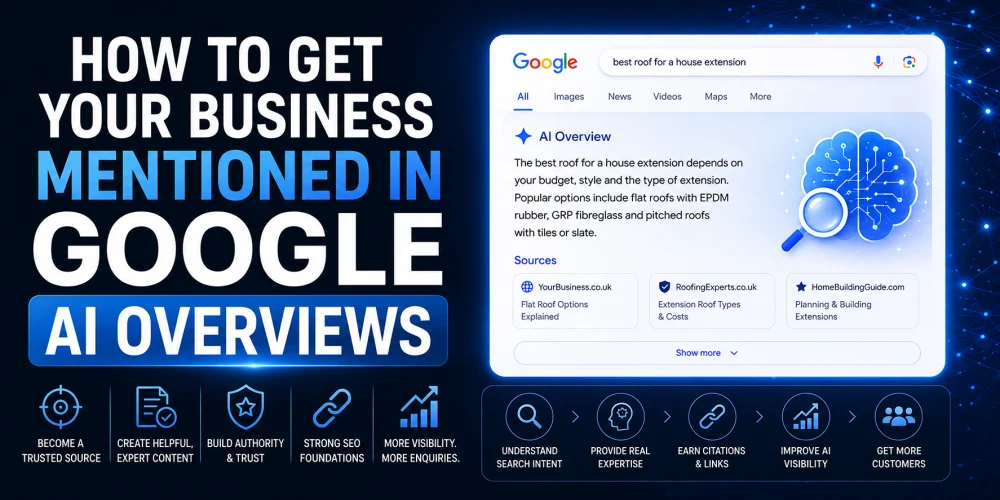
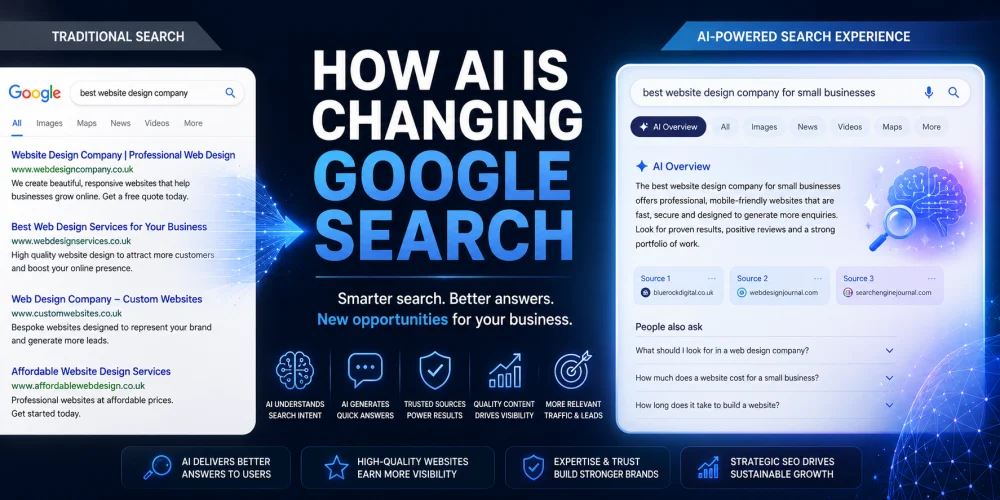

How to Get Your Business Mentioned in Google AI Overviews is becoming an important question for businesses that depend on Google for new customers. Search results are changing, and ranking in the traditional organic listings is no longer the only opportunity for your business to gain valuable visibility.
Google AI Overviews can provide AI-generated answers directly within the search results. Crucially, these answers can include links to websites that Google uses to support the information it presents.
For businesses, that creates another opportunity to be discovered.
However, there isn’t a special piece of code, secret AI schema or simple switch that guarantees inclusion. Google states that the established foundations of SEO continue to apply to its generative AI search features.
Therefore, businesses need to think beyond simply adding more keywords to their websites. Strong technical SEO, useful content, first-hand expertise, clear website structure and genuine authority all play a part.
This guide explains how Google AI Overviews work, what Google currently recommends and the practical steps your business can take to improve its chances of appearing.
What Are Google AI Overviews?
Google AI Overviews are AI-generated responses that can appear within Google Search.
Instead of requiring somebody to visit several websites to understand a subject, Google can bring together information and provide an overview directly within the results.
Importantly, these responses can contain links to supporting websites.
Therefore, AI Overviews haven’t removed websites from the equation. Google still needs information from the web to understand subjects and support the answers it generates.
The difference lies in how that information may be discovered.
Traditional SEO has largely concentrated on getting a webpage into one of the highest organic positions for a particular search.
AI-powered search is more complex.
Google may explore different aspects of a question and identify supporting information from several sources. Consequently, a website could potentially gain visibility because one section of a page provides particularly useful information about part of a broader question.
That changes how businesses should think about content.
Instead of creating pages purely around individual keywords, businesses need to demonstrate genuine knowledge of the subjects their customers care about.
How Does Google Choose Sources for AI Overviews?
There is no publicly available checklist that guarantees selection.
However, Google has provided useful information about how its generative AI search systems find and use information.
Google explains that its AI search features are rooted in its existing Search ranking and quality systems. They can use techniques including retrieval-augmented generation, commonly called RAG, to retrieve relevant and current information from Google’s Search index.
Another important technique is known as query fan-out.
What does query fan-out mean?
Imagine somebody asks Google:
“What’s the best type of roof for a house extension?”
That appears to be one question.
However, answering it properly could involve several related subjects, including:
- Different flat and pitched roof options
- Installation costs
- Expected lifespan
- Planning considerations
- Insulation
- Maintenance requirements
Google’s AI systems can explore related searches and subtopics to develop a more comprehensive response.
For businesses, this has an important implication.
You don’t necessarily need to create a separate page for every possible question somebody might ask.
Instead, you need comprehensive, well-organised content that demonstrates genuine knowledge of your subject.
A roofing company, for example, could publish a detailed guide comparing extension roofing options based on its experience installing them.
That provides something substantially more useful than another generic article listing five types of roof.
Do You Need Special SEO for Google AI Overviews?
This is where there has been considerable confusion.
You may have seen references to AI SEO, Answer Engine Optimisation (AEO) and Generative Engine Optimisation (GEO).
These disciplines can be useful ways of describing strategies designed to improve visibility across emerging AI platforms. However, Google’s own guidance is very clear about its Search product.
Google says there are no additional technical requirements for appearing in AI Overviews or AI Mode beyond those required for Google Search.
In other words, there isn’t a special AI Overview schema that guarantees inclusion.
You don’t need to create hundreds of pages answering slightly different versions of the same question either.
In fact, doing so could create the opposite result if it produces large volumes of low-value or repetitive content.
For Google specifically, the foundations remain familiar:
- Make your website crawlable.
- Ensure important pages can be indexed.
- Create useful content for people.
- Make content easy to discover through internal links.
- Provide a good page experience.
- Keep important information available as text.
- Use appropriate structured data accurately.
- Keep your business information current.
Therefore, businesses shouldn’t abandon traditional SEO because AI search has arrived.
They should strengthen it.
How to Get Your Business Mentioned in Google AI Overviews With Better Content
Content quality is one of the most important areas to address.
However, “quality content” has become an overused phrase in SEO. It is worth understanding what it actually means.
Google’s latest generative AI search guidance makes an interesting distinction between commodity content and non-commodity content.
Commodity content provides information that almost anybody could publish.
For example:
“10 Benefits of Having a New Website”
There may be nothing factually wrong with the article. However, thousands of similar articles already exist.
It adds very little that is new.
Non-commodity content provides something more distinctive.
For example:
“What We Learned From Rebuilding a 12-Year-Old WordPress Website With 150 Pages”
That article could include genuine problems encountered during the project, decisions made, performance improvements, migration issues and measurable results.
It contains experience that cannot simply be copied from the first five Google results.
Add genuine experience to your content
This presents an enormous opportunity for small businesses.
A drainage company has real experience solving drainage problems.
A roofer has real experience repairing leaking roofs.
An accountant understands the questions clients repeatedly ask.
An engineering company possesses specialist technical knowledge.
A solicitor understands situations that frequently cause clients problems.
That experience is valuable content.
Instead of producing generic articles about your industry, explain what you actually encounter.
Discuss unusual problems.
Show completed projects.
Explain why one solution worked better than another.
Include photographs where appropriate.
Discuss mistakes customers commonly make.
Explain how you diagnose problems.
Most importantly, provide information somebody couldn’t easily obtain from hundreds of other websites.
Why E-E-A-T Still Matters in AI Search
Google uses the concept of E-E-A-T when discussing content quality.
It stands for:
- Experience
- Expertise
- Authoritativeness
- Trustworthiness
E-E-A-T isn’t a simple score that you can view inside Google Search Console.
Instead, it provides a useful framework for considering whether your website gives visitors sufficient reasons to trust its information.
For a business website, there are many practical ways to strengthen these signals.
Show who is behind the business
Anonymous websites naturally provide fewer trust signals.
Include meaningful information about your company and the people responsible for providing its services.
An About page shouldn’t simply say that you’re “passionate about customer service”.
Explain your experience.
Describe your background.
Mention relevant qualifications and professional memberships.
Where appropriate, identify who writes or reviews specialist content.
Demonstrate real work
Case studies are extremely valuable because they provide evidence of experience.
Instead of saying:
“We provide professional commercial cleaning.”
Show a commercial cleaning project.
Explain the customer’s problem, the work undertaken and the result.
Similarly, a web design company can demonstrate website projects. A roofer can document repairs. A drainage contractor can explain how a difficult blockage or structural defect was diagnosed.
First-hand evidence helps distinguish genuine businesses from websites publishing generic information.
Keep information accurate
Trust also depends on accuracy.
Review older pages regularly.
Update outdated statistics.
Check prices and service information.
Remove claims that are no longer accurate.
Where you discuss important external information, reference authoritative sources rather than making unsupported claims.
Does Website Structure Affect Google AI Overviews?
Good structure helps people understand content, and it also makes pages easier for search engines to process.
You don’t need to write robotic content specifically for AI.
However, information should be logically organised.
Use descriptive H2 and H3 headings.
Keep paragraphs manageable.
Answer important questions clearly.
Use lists when they genuinely improve comprehension.
Avoid hiding essential information inside images.
Most importantly, don’t bury the answer underneath hundreds of words of unnecessary introduction.
If somebody searches for “How long does an EPDM roof last?”, a useful page should answer that question clearly before expanding on the factors that affect lifespan.
Clear writing benefits people first, but it also makes individual passages easier to understand within a broader page.
Can Your Existing Service Pages Appear in AI Overviews?
Yes, potentially.
You don’t need to turn every page into a blog article.
Service pages contain valuable information, particularly when they answer the questions potential customers genuinely ask before buying.
Consider a typical service page containing little more than:
“We provide professional driveway cleaning throughout Worcestershire. Contact us for a free quote.”
It explains what the company does, but it offers Google very little useful information about driveway cleaning.
A stronger page could explain:
- Which surfaces can be cleaned
- How the cleaning process works
- How weeds and moss are treated
- Whether pressure washing can damage paving
- How long cleaning normally takes
- Whether re-sanding is required
- How frequently driveways need cleaning
- Which problems require specialist treatment
Now the page isn’t simply advertising a service.
It is also demonstrating expertise.
That’s much more useful to customers and gives search engines greater context about the business.
Why Topical Authority Is Becoming More Important
One excellent article doesn’t automatically establish expertise.
Your website should demonstrate knowledge across the important subjects associated with your services.
Suppose you operate a drainage company.
A comprehensive website might contain service pages about drain unblocking, CCTV surveys, drain repairs, root ingress, patch lining and drain relining.
Supporting articles could answer questions about recurring blockages, damaged drains, sewage smells, overflowing manholes and rodent entry through drainage systems.
Together, these pages create a connected body of information.
Internal links then help users move between relevant subjects while helping Google understand how the pages relate to each other.
This is one reason a planned content strategy is more effective than publishing random blog articles whenever somebody remembers the company has a blog.
Why Internal Linking Matters for AI Search
Internal links remain an important part of SEO.
Google specifically recommends making content easy to find through links from other pages on your website.
For example, this article naturally relates to our SEO services, because strong traditional SEO provides the foundation for visibility across Google Search.
Businesses that want to expand their visibility beyond traditional search can also explore our Generative Engine Optimisation services.
Meanwhile, our guide explaining what GEO is and why your business needs it provides further background on how AI-powered discovery is changing digital marketing.
These aren’t links added simply for SEO.
Each one gives somebody reading this article a logical route to more detailed information about a related subject.
That is what good internal linking should achieve.
Does Schema Markup Get You Into Google AI Overviews?
Schema markup remains useful, but there is an important distinction to make.
Google specifically says you don’t need special schema.org structured data to appear in AI Overviews or AI Mode.
Therefore, businesses should be cautious about anyone claiming they can guarantee AI Overview inclusion by installing a particular schema type.
However, structured data still has legitimate SEO uses.
It helps search engines understand certain information on webpages and can make pages eligible for supported search features.
The important requirement is accuracy.
Structured data should reflect information that genuinely appears on the page. Adding misleading markup won’t turn weak content into an authoritative source.
Think of schema as part of good technical implementation rather than a shortcut into AI results.
Does Your Website Need an llms.txt File for Google AI Overviews?
Not for Google Search.
This is another area where confusion has developed.
Google’s guidance states that website owners don’t need to create new machine-readable AI files to appear in its AI features.
Therefore, a llms.txt file is not a requirement for inclusion in Google AI Overviews.
That doesn’t mean every emerging AI optimisation technique is irrelevant to every platform. Different AI services work differently, and the wider field of Generative Engine Optimisation extends beyond Google.
However, if somebody tells you that adding llms.txt will make Google include your company in AI Overviews, that claim isn’t supported by Google’s current guidance.
For Google, concentrate first on the things that demonstrably matter: accessibility, indexing, content quality, authority and established SEO fundamentals.
Why Your Technical SEO Still Matters
Outstanding content cannot perform effectively if Google struggles to access it.
Technical SEO therefore remains an important foundation for AI search visibility.
Your important pages should return successful HTTP responses and remain accessible to Googlebot.
Check that robots.txt isn’t unintentionally blocking valuable areas of your website.
Review canonical tags.
Check indexing within Google Search Console.
Resolve broken internal links.
Maintain sensible URL structures.
Ensure XML sitemaps remain accurate.
For websites heavily dependent on JavaScript, make sure essential content can still be processed correctly.
Google can process JavaScript, but JavaScript-heavy websites can create additional SEO complexity.
Good technical SEO doesn’t guarantee that your business will appear in an AI Overview. However, technical problems can prevent excellent content from having the opportunity in the first place.
Why Page Experience Still Matters
Getting mentioned is only part of the objective.
Ultimately, you want people to visit your website and become customers.
If somebody clicks through from an AI Overview and reaches a slow, confusing or difficult-to-use website, the additional visibility has achieved very little.
Google continues to recommend providing a good page experience.
That means thinking about:
- Mobile usability
- Loading performance
- Clear navigation
- Readable typography
- Intrusive pop-ups
- Page layout
- Accessibility
- Calls to action
The goal shouldn’t simply be “get cited by AI”.
The real goal is to attract the right potential customers and then provide an experience that encourages them to take the next step.
Are Images and Videos Important for AI Search?
Yes, when they genuinely add value.
AI-powered search isn’t restricted to text.
Google’s generative AI guidance specifically encourages website owners to support textual information with relevant, high-quality images and videos where appropriate.
For many businesses, original imagery is particularly valuable.
A builder can photograph completed extensions.
A roofer can document repair work.
A cleaning company can show genuine before-and-after results.
A manufacturer can demonstrate equipment or production processes.
A web designer can present completed projects and explain the thinking behind them.
Original media provides another opportunity to demonstrate first-hand experience rather than simply repeating information available elsewhere.
Optimise those assets properly too.
Use descriptive filenames where appropriate, meaningful ALT text, suitable compression and contextual placement within the page.
Does Your Google Business Profile Affect AI Visibility?
For local businesses, accurate business information remains important.
Google specifically recommends keeping Business Profile information up to date as part of its guidance for AI features.
Check that your:
- Business name is correct
- Primary category accurately represents the business
- Opening hours are current
- Website address is correct
- Telephone number works
- Services are properly represented
- Photographs remain current
Reviews also matter to potential customers, regardless of whether they arrive through AI-powered or traditional search.
A business claiming extensive experience on its website while displaying an incomplete, neglected online presence creates inconsistent signals.
Consistency helps build confidence.
Should You Create Hundreds of Pages for AI Questions?
No.
This is one of the most important warnings for businesses embracing AI search optimisation.
Query fan-out means AI systems may explore numerous related questions. It might therefore seem logical to create a separate page targeting every possible variation.
Google specifically warns against this approach when pages are produced primarily to manipulate rankings or generative AI responses.
More pages don’t automatically mean greater authority.
Twenty excellent resources can be substantially more valuable than 500 thin pages.
Before publishing anything, ask:
“Does this page provide something genuinely useful that isn’t already adequately covered elsewhere on our website?”
If the answer is no, consider improving an existing page instead.
Can AI-Generated Content Appear in Google AI Overviews?
Using AI to assist content creation isn’t automatically a problem.
Google’s concern is value, not simply which tool helped produce the words.
AI can be extremely useful for research, planning, organising information and improving workflows.
The problem begins when businesses use it to produce hundreds of generic pages without adding genuine expertise.
If you can ask an AI tool to generate “10 Benefits of Regular Gutter Cleaning” in seconds, thousands of other businesses can do exactly the same thing.
That makes the information a commodity.
Instead, combine efficient technology with genuine human experience.
Provide examples.
Correct inaccuracies.
Add original photographs.
Include expert observations.
Explain exceptions.
Discuss what happens in the real world.
AI can help you produce content. Your expertise should make that content worth reading.
How Can You Measure Google AI Overview Visibility?
This area has improved significantly.
In June 2026, Google announced dedicated generative AI performance reporting within Search Console. The report covers visibility within AI Overviews and AI Mode.
Google says the report can show generative AI impressions over time and identify which pages receive the deepest or lowest impressions. Data can also be examined by country, device and date.
However, Google is rolling the feature out gradually, so not every Search Console property currently has access.
An impression essentially indicates that a link to your site was shown to somebody within a supported generative AI Search feature.
This provides businesses and SEO professionals with much better evidence of AI visibility than repeatedly performing manual searches and hoping to see a particular brand mentioned.
Nevertheless, impressions alone aren’t the final objective.
You should also monitor meaningful business outcomes, including enquiries, telephone calls, sales and qualified leads.
Visibility has value when it contributes to commercial results.
Can You Guarantee a Business Will Appear in Google AI Overviews?
No reputable SEO company should guarantee it.
Google doesn’t guarantee that a page will be crawled, indexed, ranked or selected for an AI-generated response simply because it follows best practices.
AI Overviews also don’t appear for every query.
Furthermore, the sources selected can change.
Therefore, the sensible objective is to improve eligibility, relevance, authority and the probability of visibility, rather than promise a particular citation.
This is similar to traditional SEO.
You can create the strongest possible conditions for success, but nobody outside Google controls Google’s search results.
What Should You Do to Improve Your AI Overview Visibility?
If you want to know how to Get Your Business Mentioned in Google AI Overviews, start with the fundamentals rather than looking for shortcuts.
First, make sure Google can properly crawl and index your website.
Next, review your most important service pages. Ask whether they genuinely demonstrate expertise or merely advertise what you sell.
Then examine your existing blog content. Replace generic subjects with content based on genuine customer questions, practical experience, case studies and original insights.
Strengthen internal linking between related resources.
Review your About page, author information, case studies, reviews and other trust signals.
Keep your Google Business Profile accurate if you serve local customers.
Use relevant original images and videos where they add useful context.
Finally, measure what happens.
If you have access to Google’s generative AI performance report in Search Console, monitor which pages are gaining impressions. Look for patterns and use those insights to improve other areas of your website.
Most importantly, don’t abandon traditional SEO.
Google’s own 2026 guidance makes it clear that SEO remains the foundation of visibility in its generative AI search experiences.
Is Your Business Ready for Google AI Search?
AI Overviews are changing the way information appears in Google, but the fundamental objective hasn’t changed.
Google still wants to connect people with useful, reliable information.
The businesses most likely to benefit are therefore those prepared to demonstrate genuine knowledge rather than manufacture content simply to target keywords.
Strong technical SEO gets your content discovered.
Useful content demonstrates expertise.
Original experience differentiates your business.
Clear website structure makes information easier to understand.
Authority and trust give both users and search systems greater confidence in what you publish.
At Blue Rock Digital, we combine traditional SEO services with Generative Engine Optimisation to help businesses improve their visibility across both conventional search results and emerging AI-powered search experiences.
If you’re unsure whether your website is ready for this shift, we can assess your current search and AI visibility, review your content and identify practical opportunities for improvement.
The objective isn’t to chase every new AI trend.
It’s to build a website and digital presence that search engines, AI systems and, most importantly, potential customers have good reasons to trust.