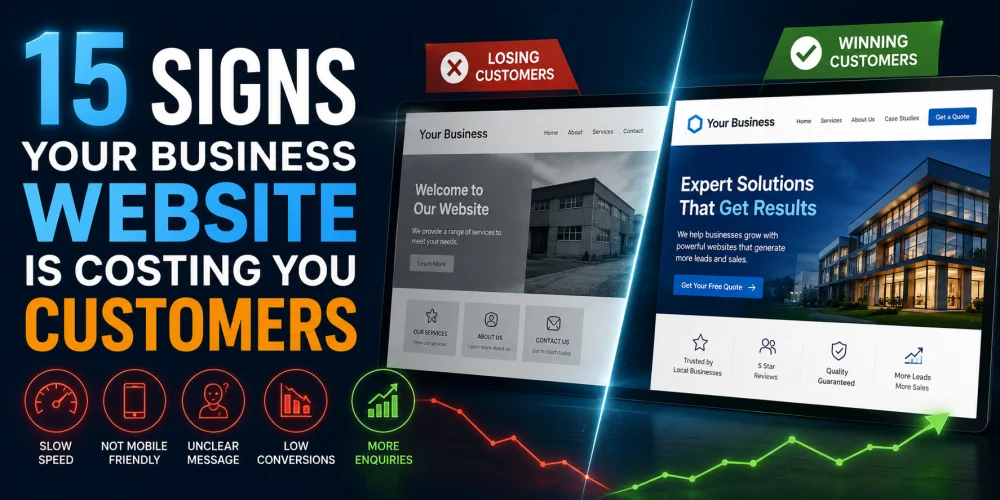
Your website should be your hardest-working salesperson. It should attract visitors, build trust, answer questions and encourage potential customers to get in touch. However, many business websites do the exact opposite. Instead of generating enquiries, they create frustration, lose credibility and send visitors straight to a competitor.
The problem is that many business owners don’t realise their website is underperforming. They see visitors arriving through Google, social media or paid advertising and assume everything is working as expected. Unfortunately, website traffic means very little if those visitors don’t become customers.
A modern website needs to do far more than simply look attractive. It must load quickly, perform flawlessly on every device, provide useful information and guide visitors towards taking action. If any of these elements are missing, your conversion rate can suffer significantly.
If you’re wondering why enquiries have slowed down or why competitors appear to win more business, your website could be the reason.
Here are fifteen signs that your website may be costing you customers.
1. Your Website Loads Slowly
First impressions happen within seconds. If your website takes too long to load, many visitors won’t wait around.
Modern users expect websites to load almost instantly. Research consistently shows that slower websites experience higher bounce rates, lower engagement and fewer enquiries.
A slow website can be caused by large image files, poor hosting, outdated software, excessive plugins or inefficient code.
Website speed also influences Google rankings. Faster websites generally provide a better user experience, which Google rewards.
Improving loading speed benefits both your SEO and your conversion rate.
2. It Doesn’t Work Properly on Mobile Devices
More than half of website traffic now comes from smartphones.
If visitors need to zoom in to read text, struggle to press buttons or find navigation confusing, they’ll simply leave.
Google also uses mobile-first indexing, meaning it primarily evaluates the mobile version of your website when determining rankings.
A responsive design is no longer optional. Every page should function perfectly across phones, tablets and desktop computers.
3. Your Website Looks Outdated
People naturally judge businesses by their appearance.
An outdated website can create doubts about your professionalism before visitors even read a single sentence.
Old-fashioned layouts, poor-quality images, inconsistent fonts and dated colour schemes all reduce trust.
A modern website immediately communicates professionalism and confidence.
If your website hasn’t been redesigned for several years, it could be giving visitors the wrong impression.
4. Your Message Isn’t Clear
Visitors should understand exactly what your business does within seconds.
Unfortunately, many websites rely on vague marketing phrases that say very little.
Instead of writing:
“Providing innovative business solutions.”
Explain exactly what you do.
For example:
“Professional SEO and website design that helps local businesses generate more enquiries.”
Clear messaging reduces confusion and keeps visitors engaged.
5. You Don’t Have Strong Calls to Action
Visitors need direction.
If every page ends without telling people what to do next, many will simply leave.
Good calls to action include:
- Request a Free Quote
- Book a Consultation
- Call Our Team Today
- Get Your Free Website Audit
Every important page should encourage visitors to take the next step.
6. Your Contact Information Is Difficult to Find
Potential customers shouldn’t have to search for your phone number.
Display your contact details prominently throughout the website.
This includes:
- Header
- Footer
- Contact page
- Service pages
The easier it is to contact you, the more enquiries you’ll receive.
7. Your Website Doesn’t Build Trust
People buy from businesses they trust.
Trust signals can dramatically increase conversions.
These include:
- Google Reviews
- Testimonials
- Case studies
- Before and after images
- Industry accreditations
- Professional photography
- Years of experience
- Guarantees
Every trust signal reduces uncertainty.
8. Your Content Focuses on You Instead of the Customer
Many websites spend too much time talking about themselves.
Customers care about one thing:
“Can this business solve my problem?”
Instead of listing company achievements, explain how your services benefit customers.
Focus on outcomes rather than features.
9. Your Website Isn’t Ranking Well on Google
Even an excellent website cannot generate enquiries if nobody finds it.
Search engine optimisation remains one of the most effective long-term marketing strategies.
A strong SEO strategy includes:
- Keyword research
- Optimised content
- Technical SEO
- Internal linking
- Fast loading speeds
- Quality backlinks
- Google Business Profile optimisation
Without SEO, your competitors will continue attracting your potential customers.
10. Visitors Can’t Find Information Quickly
People rarely read websites from top to bottom.
Instead, they scan.
Large blocks of text make information difficult to digest.
Use:
- Clear headings
- Short paragraphs
- Relevant images
- Icons
- White space
Good formatting dramatically improves readability.
11. Your Website Doesn’t Demonstrate Expertise
People want reassurance before making contact.
Publishing helpful content demonstrates knowledge and experience.
Examples include:
- Blogs
- Guides
- Case studies
- FAQs
- Industry insights
Helpful content also strengthens your SEO.
12. Your Website Has Broken Links or Errors
Nothing damages credibility faster than broken pages.
Common issues include:
- 404 errors
- Missing images
- Outdated information
- Broken contact forms
- Incorrect phone numbers
Regular maintenance prevents these problems.
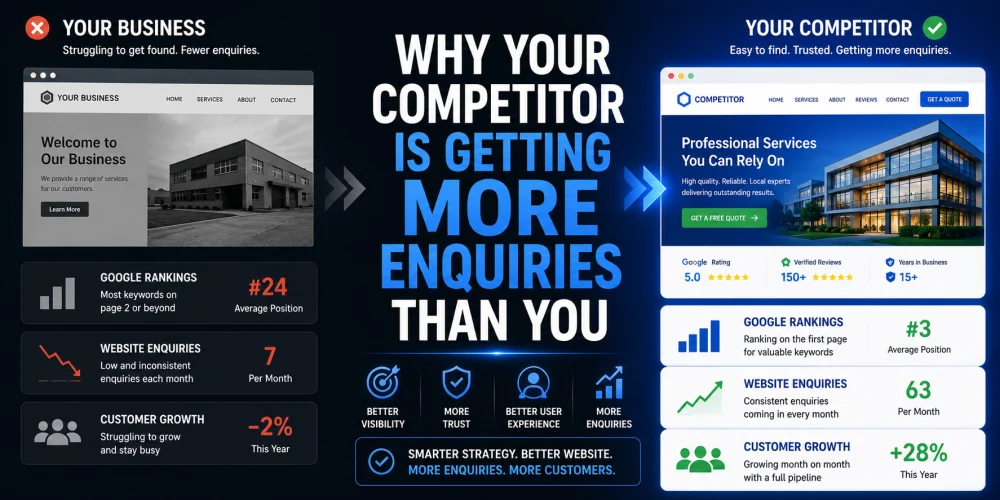
13. Your Competitors Have Better Websites
Potential customers often compare several businesses.
If a competitor’s website looks more professional, loads faster and provides more useful information, they’re far more likely to win the enquiry.
Take an objective look at competing businesses.
Ask yourself:
- Which website looks more trustworthy?
- Which is easier to use?
- Which provides better information?
Small improvements can make a significant difference.
14. You’re Not Tracking Website Performance
Without data, you’re guessing.
Tools such as Google Analytics and Google Search Console reveal:
- Where visitors come from
- Which pages perform best
- Which pages lose visitors
- Which keywords generate traffic
This information allows continuous improvement.
15. You’re Treating Your Website Like a Brochure
Many businesses launch a website and never update it again.
Successful websites evolve continually.
Regular improvements include:
- Publishing fresh content
- Updating service pages
- Improving page speed
- Adding case studies
- Refreshing photography
- Optimising SEO
A website should grow alongside your business.
Your Website Should Be Generating Enquiries Every Week
If several of these signs sound familiar, don’t worry. Most websites can be transformed through better design, improved SEO and a stronger focus on user experience.
Small improvements often produce significant increases in enquiries without increasing your advertising budget.
At Blue Rock Digital, we help businesses create websites that don’t just look professional—they rank well on Google, build trust and convert visitors into customers.
Whether you need a complete website redesign, ongoing SEO or a full digital marketing strategy, our team can help you turn your website into a valuable business asset.
If you’re unsure how your current website is performing, get in touch for a professional website audit. We’ll identify what’s working, what’s holding your website back and the practical improvements that could help you generate more enquiries.