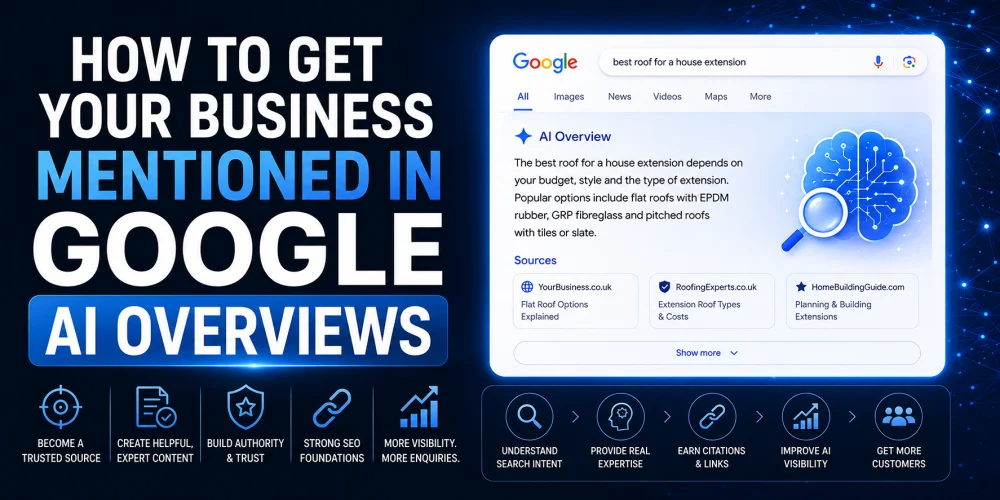
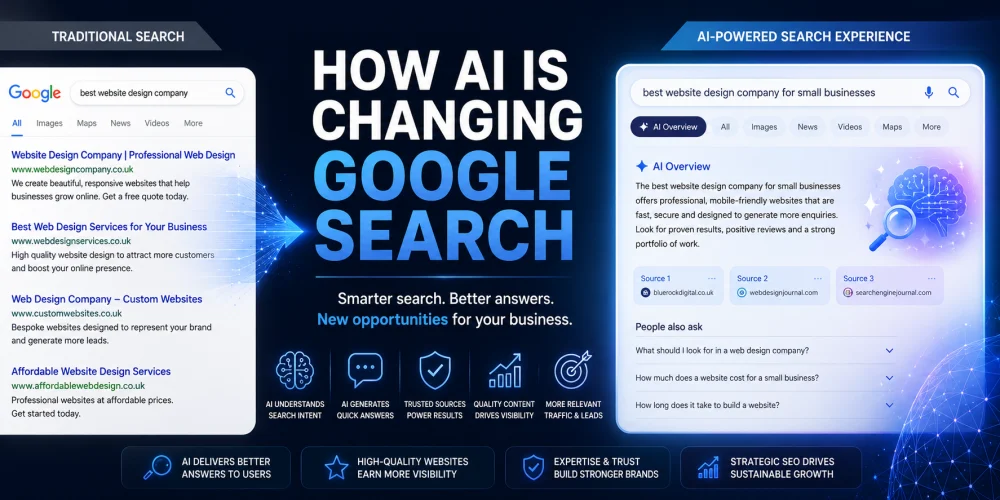


AI is fundamentally changing how Google processes search queries. Features like AI Overviews, MUM, and RankBrain now influence which results appear, how answers are presented, and what counts as relevant content. For businesses, this means the rules of SEO are evolving.
This guide explains the key ways AI is affecting Google searches and what website owners need to do to adapt.
How AI is Affecting Google Searches and What SEO Changes Websites Need to Make
Here, we explain how AI is Affecting Google Searches. Artificial Intelligence (AI) is transforming how Google processes search queries. Thanks to AI models like RankBrain, BERT, and MUM, Google’s search algorithms have become more intelligent. These advancements allow Google to better understand user intent and context and deliver more personalised results. As AI plays a more prominent role in shaping search, website owners must adapt their SEO strategies to stay competitive.
Let’s explore how AI is changing Google searches and what SEO changes are necessary for websites to keep pace. If you want to go further and optimise for AI tools beyond Google, read our guide to what GEO is and why your business needs it. If you want to go further and optimise for AI tools beyond Google, read our guide to what GEO is and why your business needs it.
How AI is Changing Google Searches
1. Improved Understanding of User Intent
Google no longer relies solely on keywords to deliver search results. Instead, AI models like RankBrain focus on understanding the intent behind a query. This shift means that Google can better interpret vague or long-tail searches. For example, a user typing “best affordable golf clubs” might receive a more precise result because Google understands that the searcher wants a product recommendation within a specific budget.
2. Natural Language Processing with BERT
Google’s BERT model is designed to understand the context and nuances of human language. With BERT, Google can now comprehend more complex and conversational queries. For instance, BERT helps interpret searches like “where to buy running shoes near me,” ensuring that the results are more contextually relevant.
3. Multimodal Search with MUM
AI models such as MUM enable Google to provide answers across different formats, such as text, images, and video. MUM can combine insights from multiple sources to deliver more comprehensive results. In turn, this affects how users interact with Google search, with people expecting results not only in the form of traditional links but also rich media like videos and images.
4. Personalised Search Results
AI allows Google to personalise search results based on user behaviour, location, and preferences. For example, someone searching for “best restaurants” in London may see results tailored to their previous search history, preferences, or reviews they’ve engaged with. Search results vary widely depending on individual profiles, making SEO more challenging.
SEO Changes Websites Need to Keep Pace with AI
Website owners must adapt their SEO strategies to stay ahead in AI-driven searches. Google provides guidance on this in their AI Overviews documentation. Here are the key changes to consider:
1. Optimise for User Intent
Because Google is prioritising user intent over exact keyword matching, website content must focus on answering real questions and solving user problems. Rather than stuffing pages with repetitive keywords, create content that is:
- Relevant to search intent (informational, transactional, or navigational)
- Helpful and thorough in addressing user needs
- Structured to offer clear answers to common queries
By focusing on creating high-quality, informative content, you will rank higher in AI-driven search results.
2. Use Natural Language
As AI models like BERT continue to evolve, Google rewards content written in a natural, conversational tone. This means you should:
- Avoid overly technical jargon unless necessary.
- Write in a clear, easy-to-understand way.
- Answer questions directly, which helps with voice search optimisation.
By writing more naturally, your content will be better positioned for AI-driven searches, especially as voice searches become more common.
3. Leverage Structured Data (Schema Markup)
AI relies heavily on structured data to understand and present content. Using schema markup, you can help Google interpret your content more efficiently, increasing your chances of appearing in rich results, such as featured snippets or knowledge graphs. For example, adding structured data to a product page allows Google to display price, availability, and reviews directly in search results.
To implement schema, you should:
- Use FAQ schema to target question-based queries.
- Apply LocalBusiness schema if you run a local business.
- Ensure structured data is used on product pages for e-commerce websites.
This improves your site’s visibility and makes your content more attractive to Google’s AI-powered algorithms. For a full breakdown of every technique involved, see our guide to optimising your website for AI search engines. For a full breakdown of every technique involved, see our guide to optimising your website for AI search engines.
4. Focus on Mobile-First and User Experience
Google’s AI-driven algorithms heavily prioritise mobile-friendly and user-centric design. To ensure your site ranks well:
- Make your site fully responsive, ensuring it adapts to all screen sizes.
- Improve page load speeds, as slow sites are penalised.
- Simplify navigation, making it easy for users to find what they need quickly.
Google’s AI increasingly emphasises websites that offer a smooth, fast, and engaging user experience.
5. Optimise for Voice Search
Optimising for voice search is key as more users rely on voice assistants like Google Assistant. Voice searches tend to be more conversational and specific, so websites need to:
- Focus on long-tail keywords that reflect natural speech patterns.
- Create FAQ pages to answer commonly searched questions.
- Use local keywords, especially if targeting local searches.
By adapting content for voice search, you’re preparing your website for the increasing number of users asking AI-driven, spoken queries.
6. Incorporate Visual and Multimedia Content
AI-powered search algorithms are becoming more adept at processing images and videos. Optimising multimedia content is now an essential part of SEO. To take advantage of this shift:
- Add alt text to all images, helping AI understand visual content.
- Optimise video metadata, including titles and descriptions.
- Use image optimisation to ensure fast loading times.
Visual content plays an increasingly significant role in search, especially with AI’s capacity to interpret different media formats.
7. Build Authoritative Backlinks
AI-powered Google searches continue to value authoritative backlinks as a key ranking signal. Therefore, you should:
- Focus on acquiring backlinks from reputable websites in your industry.
- Create link-worthy content such as guides, infographics, or original research.
- Build relationships with influencers and thought leaders who can link to your site.
By building a solid backlink profile, you increase your site’s credibility in the eyes of AI, improving your search rankings. For a practical approach to improving your AI search presence, explore our guide to implementing llms.txt for AI search visibility. You can also learn how ChatGPT’s Deep Research Agent is demonstrating the growing power of AI-driven research tools.
How AI is Reshaping Google Searches and What SEO Strategies Keep You Ahead
AI is reshaping Google searches, making them more intuitive, personal, and multimodal. To keep pace, website owners must shift their SEO strategies towards user intent, natural language, structured data, and mobile-first experiences. As AI advances, websites that focus on delivering high-quality, helpful content and a smooth user experience will stay ahead in Google’s ever-evolving search landscape.
As AI-powered tools like ChatGPT and Perplexity become significant discovery channels in their own right, Generative Engine Optimisation is becoming just as important as traditional search visibility. Our guide on how to appear in AI search results in 2026 covers the practical steps your business can take today.